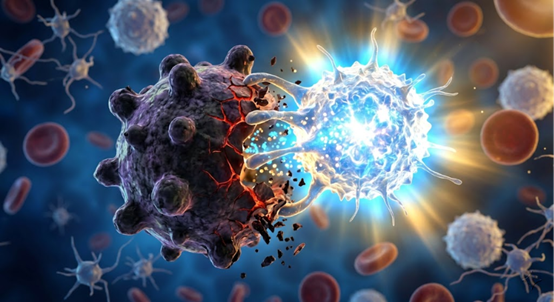
The human body already has a powerful defense force—the immune system, with T cells serving as the frontline fighters. Logically, when abnormal cancer cells appear in the body, T cells should immediately destroy them. But why does cancer still develop?
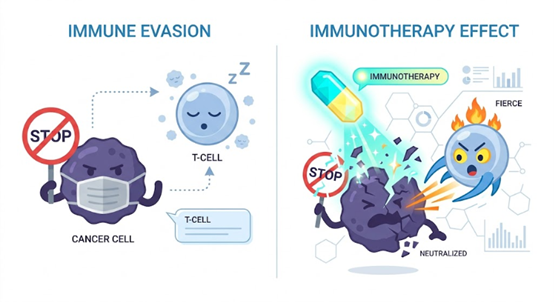
The reason is that cancer cells are very cunning. They have evolved a “camouflage mechanism” capable of sending false signals to immune cells saying “I’m one of us, don’t fire.” At the molecular level, cancer cells heavily express PD-L1 protein, which binds to the PD-1 receptor on the surface of T cells—essentially issuing a “ceasefire” command to the immune system, causing T cell function to be suppressed or even undergo apoptosis [1]. This is like putting a blindfold on T cells, making the defense force blind to the enemy right in front of them. And “immunotherapy,” which has revolutionized the medical world in recent years, has as its core purpose the tearing off of cancer cells’ disguise.
The Key Technology: “Immune Checkpoint Inhibitors” That Expose the Disguise
The most widely applied immunotherapy today is called “immune checkpoint inhibitors.”
Think of it this way: traditional chemotherapy or targeted drugs directly throw poison or missiles at cancer cells; but immune checkpoint inhibitors themselves “do not” possess the ability to kill cancer cells. Their function is to block the false signals emitted by cancer cells—essentially helping the immune system “release the brakes” and “remove the blindfold” [2].
Once T cells can once again see the true face of the enemy, the paralyzed immune defense line suddenly awakens, using the patient’s “own” immunity to devour and annihilate cancer cells.
The Long-Tail Effect: Turning Advanced Cancer Into a Manageable “Chronic Disease”
The most exciting aspect of immunotherapy’s ability to rewrite the cancer treatment playbook is its unique “long-tail effect.”
Past treatments were often “effective while taking medication, relapsing after stopping.” But the immune system has “memory.” Once T cells learn how to identify and attack specific cancer cells, even after the course of treatment ends and medication stops, these memory-equipped defenders continue to patrol inside the body.
Clinically, many patients with previously untreatable advanced cancer have not only seen their tumors significantly shrink after immunotherapy but have even been able to coexist with cancer long-term. For advanced melanoma, for example, the 5-year overall survival rate for patients using combined anti-CTLA-4 and anti-PD-1 inhibitors is approximately 50%—a revolutionary breakthrough compared to the historical figure of less than 10% [3]; advanced non-small cell lung cancer patients receiving pembrolizumab treatment achieved a 5-year overall survival rate of 25%, far exceeding the 8.2% of traditional chemotherapy [4]. Cancer is no longer an immediately fatal incurable disease, but has the possibility of transforming into a “chronic disease” like hypertension or diabetes that can be stably controlled with regular clinic visits.

Practical Reminder: Be Aware of This “Double-Edged Sword” and Watch for Body Warning Signs
Although immunotherapy sounds like a miracle, it is not a panacea and is not suitable for everyone.
When we remove the “brakes” from the immune system, the defense force may become overexcited, causing them to attack not only cancer cells but also normal organs—this is medically called “immune-related adverse events (irAEs).” A systematic literature review covering 125 clinical trials with 20,128 patients showed that among patients receiving PD-1/PD-L1 inhibitor treatment, the overall incidence rate of all-grade irAEs reached as high as 66%, with a grade 3 or above serious adverse event rate of approximately 14% [5].
Practical reminders for patients and families:
Pre-treatment evaluation: Before administration, doctors will usually recommend testing for specific biomarkers (such as PD-L1 expression levels) to evaluate whether immunotherapy is truly effective for you, avoiding unnecessary expenses. Currently, PD-L1 expression level is the most widely used clinically validated predictive biomarker for immunotherapy response, but overall only 20–40% of patients can benefit from immunotherapy, so pre-treatment evaluation is crucial [6].
Side effects that cannot be ignored: The side effects of immunotherapy are different from the hair loss or vomiting of traditional chemotherapy—they mostly manifest as “inflammatory reactions.” If abnormal fever, severe diarrhea, unexplained shortness of breath and coughing, or large areas of skin rashes occur during treatment, absolutely do not adopt a “wait and see” attitude—you must “immediately” report to the medical team. Early treatment means a safe outcome [5].
【Expert Reminder】
Your body is your strongest weapon. During immunotherapy, maintaining balanced nutrition and adequate sleep, not casually taking folk remedies that interfere with the immune system, is the best logistical support for the “defense force” inside you!
References
Chen Y, et al. Regulatory mechanisms of PD-1/PD-L1 in cancers. Molecular Cancer. 2024. doi: 10.1186/s12943-024-02023-w
Wu Q, et al. Immune evasion in cancer: mechanisms and cutting-edge therapeutic approaches. Signal Transduction and Targeted Therapy. 2025. doi: 10.1038/s41392-025-02280-1
Larkin J, et al. Immune checkpoint inhibitors in melanoma. The Lancet. 2021;398(10304):1003–1014. doi: 10.1016/S0140-6736(21)01206-X
Hermida LC, et al. Long-term survival of patients with advanced non-small cell lung cancer treated using immune checkpoint inhibitors. Lung Cancer. 2023. doi: 10.1016/j.lungcan.2023.107323
Xu C, et al. Immune-related adverse events of immune checkpoint inhibitors: a review. Frontiers in Immunology. 2023. doi: 10.3389/fimmu.2023.1167975
Gibney GT, et al. PD-L1 as a biomarker of response to immune-checkpoint inhibitors. Nature Reviews Clinical Oncology. 2021. doi: 10.1038/s41571-021-00473-5