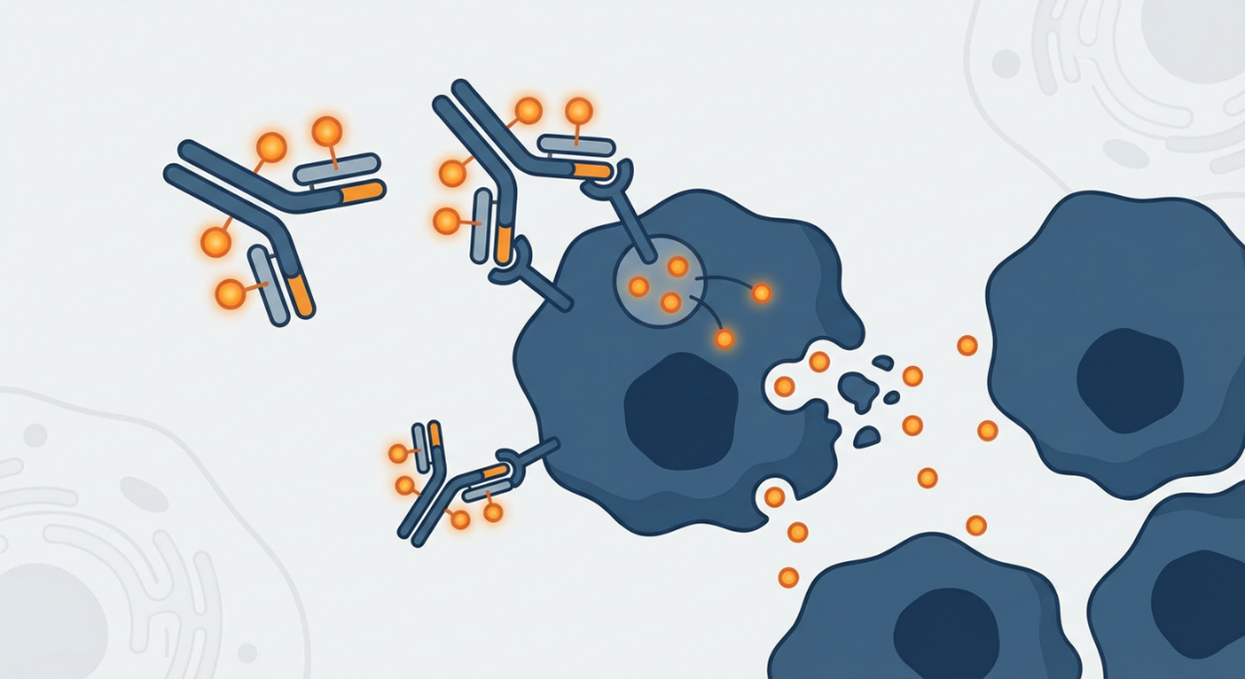
Antibody-Drug Conjugates (ADCs) are reshaping the direction of modern oncology treatment at a remarkable pace. Dubbed the “magic bullet” of cancer treatment, this technology combines the precise targeting capability of monoclonal antibodies with the destructive power of highly toxic chemotherapy drugs. ADCs work like cruise missiles, locking onto specific antigens on the surface of cancer cells (such as HER2, TROP-2, or Nectin-4), and precisely delivering drugs to target cells for intracellular release while minimizing damage to normal cells. The core structure of an ADC consists of three key components: first, a monoclonal antibody responsible for identifying the target; second, a “linker” that ensures the drug remains stable in circulation and is specifically released inside the tumor; and finally, a cytotoxic drug “payload” with powerful killing ability, such as topoisomerase inhibitors. Next-generation ADCs possess a powerful “bystander effect”—when the cytotoxin is released, it can further penetrate neighboring cancer cells with lower antigen expression or heterogeneity, expanding the killing range and overcoming the limitations of traditional treatments.
ADCs have currently demonstrated outstanding efficacy in solid tumors, extending from breast cancer to lung cancer, urological cancers, and other fields. In breast cancer treatment, T-DXd (Trastuzumab deruxtecan) achieved a median progression-free survival (mPFS) of up to 29 months as second-line treatment for HER2-positive metastatic breast cancer, outperforming conventional T-DM1. Additionally, its “bystander effect” creates opportunities for it to act on HER2-low expression patients, greatly expanding its indication range [1][4]. For non-small cell lung cancer (NSCLC), approximately 3% to 6% of lung adenocarcinomas carry HER2 gene mutations—these tumors are generally highly malignant and respond poorly to chemotherapy. According to clinical trial results, T-DXd achieved objective response in 50% of patients. For urothelial carcinoma, the ADC drug EV (Enfortumab vedotin) targeting Nectin-4 has also been introduced into clinical practice in Taiwan. Notably, HER2-positive expression also exists in specific solid tumors including biliary tract cancer, pancreatic cancer, endometrial cancer, and colorectal cancer, demonstrating the powerful treatment potential of ADCs across tumor type-agnostic applications.
Regarding ADC application evidence, major international journals have published multiple landmark studies. For example, the DESTINY-Breast04 trial published in the New England Journal of Medicine (NEJM) confirmed that T-DXd for HER2-low metastatic breast cancer patients can significantly improve progression-free survival and overall survival [1]. In addition, data from the DESTINY-PanTumor02 trial for multiple HER2-positive solid tumors showed that T-DXd demonstrated strong and durable tumor response in various cancer types (including endometrial cancer, cervical cancer, ovarian cancer, bladder cancer, and biliary tract cancer), with an objective response rate (ORR) as high as 50% for patients who had previously received multiple lines of treatment with limited options [2]. Current ADC technological innovations, including how to reduce off-target toxicity through engineered antibodies and optimized linkers, are flourishing, emphasizing active monitoring and management strategies for side effects such as interstitial pneumonia [3].
Taiwan has moved quickly in introducing ADC therapy, actively aligning with international treatment guidelines. Taiwan’s National Health Insurance Administration has successively included multiple next-generation ADC drugs under coverage, reducing the financial burden on patients. For example, Sacituzumab govitecan (SG), an ADC targeting TROP-2, has been gradually incorporated into NHI coverage. Additionally, Enhertu (T-DXd) officially received NHI coverage on February 1, 2025, applicable to second-line treatment for HER2-positive metastatic breast cancer or HER2-weakly positive breast cancer patients under specific conditions, with an estimated annual benefit for over a thousand cancer patients. For non-small cell lung cancer, Taiwan has also obtained indications for HER2 gene mutations. Although ADCs still face challenges such as drug resistance and side effect management, with the development of bispecific ADCs and combined immunotherapy, precision medicine for cancer treatment is moving toward a more mature new era [4].
References
Modi, S., et al. (2022). Trastuzumab Deruxtecan in Previously Treated HER2-Low Advanced Breast Cancer. The New England Journal of Medicine, 387(1), 9-20.
Meric-Bernstam, F., et al. (2024). Trastuzumab Deruxtecan in HER2-Positive Solid Tumors: Primary Analysis of the DESTINY-PanTumor02 Phase II Trial. Journal of Clinical Oncology, 42(1), 47-58.
Chen, B., et al. (2025). Antibody–drug conjugates in cancer therapy: current landscape, challenges, and future directions. Mol Cancer. 2025 Nov 3;24:279
曾令民(2025). 新一代抗體藥物複合體(ADC)在實體腫瘾治療的進展. 台北市醫師公會會刊,69(5),1-3.